
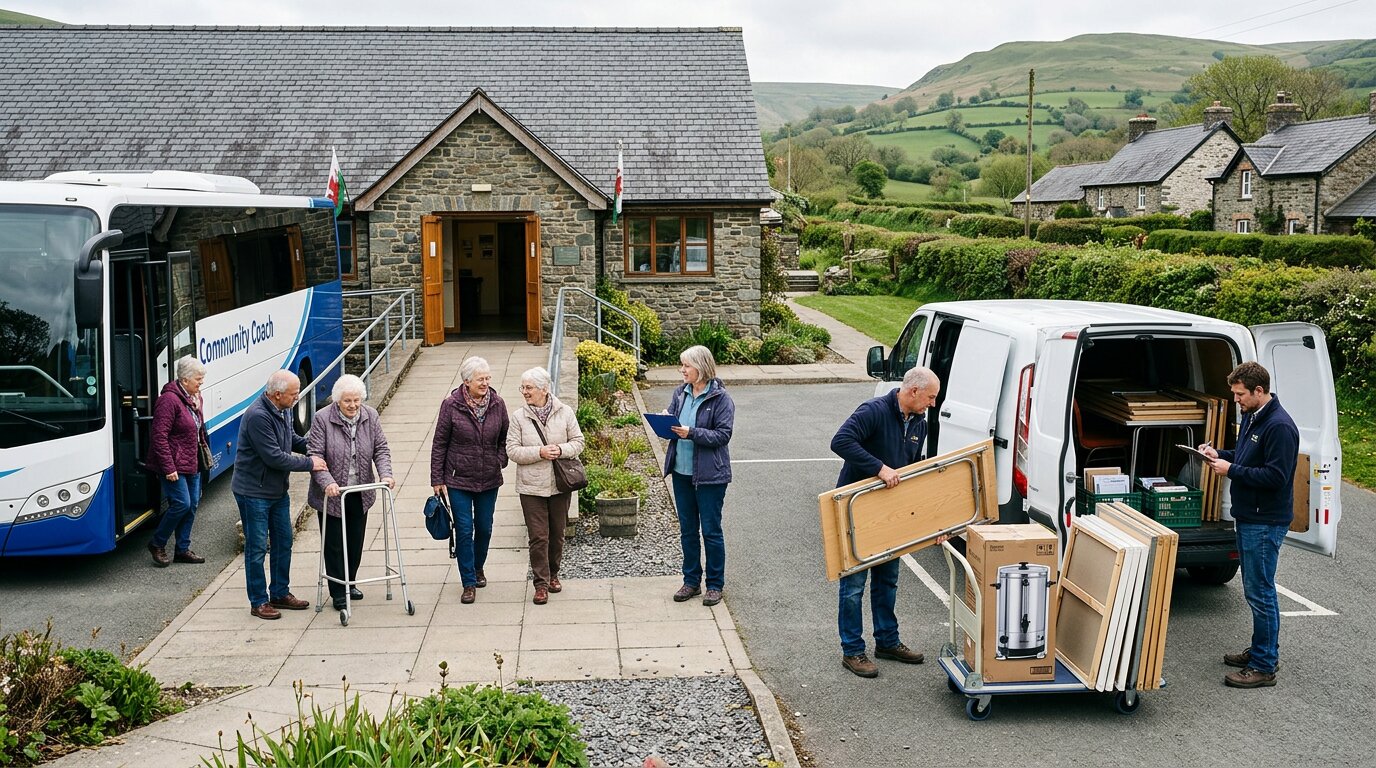
The committee has agreed the trip. Twenty-odd members want to go to mid Wales, and someone has offered to bring the display boards, the urn and the boxes of stall stock. Then the question lands on whoever volunteered to organise it: what do we actually hire?
The useful answer is to stop thinking about “a vehicle” and start thinking about two separate jobs. One is moving people. The other is moving things. They have different rules, different drivers and often different vehicles, and the trip gets simpler as soon as you plan them apart.
Write down the outing before you ring anyone
Hire firms, venues and volunteer drivers all ask the same questions. Answer them once, on one sheet, and share it with the committee. Here is a hypothetical outing brief to copy and adapt. The group, numbers and kit are invented for illustration.
| Passenger side (people) | Equipment side (things) | |
|---|---|---|
| What is moving | 22 members, two of whom use walking frames | Six folding display boards, two trestle tables, a boxed tea urn, a crate of leaflets |
| Options to verify | Coach with driver; community transport; self-drive minibus with a volunteer driver; members’ cars | A member’s estate car; a small self-drive van; the venue lending tables so less needs to travel |
| Who drives | Professional driver, or a volunteer who meets the minibus licence conditions | A member with a standard car licence, if the van is within category B limits and the driver meets the hirer’s age rules |
| Questions for the hirer | Seats, step height, wheelchair or frame storage, insurance for volunteer drivers | Load length, rear door size, deposit, excess, return time |
| Questions for the venue | Drop-off point near the door, accessible toilets, where the minibus can wait | Loading door, distance to the hall, when you can unload and when you must be gone |
| Named person responsible | Passenger lead: headcount on and off, seat plan, medical needs | Kit lead: packing list, straps, loading order, return of the van |
One rule runs through the whole sheet. People travel in proper seats, in a vehicle built and insured to carry them. Nobody rides in the back of a van with the boards, however short the hop.
The passenger side: check the driver rules first
Self-drive minibuses are popular with groups, but the licence rules catch people out. According to GOV.UK’s minibus guidance, a car licence holder can drive a minibus with up to 16 passenger seats in the UK only under specific conditions. They must be 21 or over and have held a licence for at least two years. They must be driving voluntarily for a non-commercial body using the minibus for social purposes, and there must be no payment from or on behalf of the passengers. The minibus’s maximum authorised mass must be no more than 3,500kg (4,250kg for electric or hydrogen vehicles), and they can’t tow a trailer. Drivers over 70 need to meet Group 2 medical standards.
If members are paying towards the trip, the car-licence conditions aren’t met. The same page’s section on minibus permits covers how such a trip can be run, but a permit doesn’t replace the driver’s own entitlement. Where nobody meets the conditions, you’ll need a driver with D1 entitlement, or a coach or minibus that comes with its own driver. Either way, check the hirer’s own driver rules too.
Worked example one: a hypothetical day in Newtown
Imagine a history society from the Bournemouth area spending a day in Newtown, Powys, for talks and a walk around the town. The members travel by coach from Dorset. Once there, the organisers want a second, smaller vehicle so that two members who tire easily can be taken back to the hotel early, without the whole group leaving.
That is a passenger job, and a small one. The vehicle hire information for Newtown from Wales Rentals covers car, van, minibus and truck hire and says bookings are handled by phone. An organiser would ring with the dates, the number of passengers, any mobility needs and the name of the driver, and ask which car is actually available. Confirm the insurance, the deposit and whether the vehicle can be delivered to the hotel rather than assuming it.
The equipment side: a van is simpler, but not automatic
Moving kit is usually the easier half. A standard category B licence covers vans up to 3,500kg maximum authorised mass, according to GOV.UK’s licence categories, so most small and medium panel vans need nothing special. Check the plated weight before accepting anything larger.
Pack in reverse order of need. The boards and tables go in first, against the bulkhead, and come out last. The urn and the leaflets ride near the doors. Strap everything: a display board sliding into the back doors on a bend is how corners get crushed.
Worked example two: a hypothetical display near Lampeter
A different, equally invented case. A Dorset craft circle has been offered a table at a village hall event in the Teifi valley, west Wales. Members will travel in their own cars and share lifts. The problem is the kit: display stands, a gazebo and boxed stock that won’t fit in anyone’s boot.
Here the job is cargo only, so a van makes sense. Two members could drive down in one car, collect a van locally, load it at a member’s relative’s house the night before, and take it to the hall in the morning. The Lampeter van hire options page describes van hire, from compact vans to Luton box vans with tail lifts, and says it offers delivery and collection in Lampeter. Ask what size van is actually on offer, the load length and rear door opening, and what happens if the event overruns the return time. The two members ride in the cab. The gazebo rides in the back.
Check the venue, and allow time for Welsh roads
Ring the venue before anyone books a vehicle. Ask where a coach or minibus can set down, whether there’s a loading door, how far it is from the parking to the hall, and what time you can arrive and must be cleared. A loading door at the back of a hall is useless if the only access is a lane a Luton can’t turn in.
Plan the timetable with care too. Wales introduced a default 20mph speed limit on restricted roads in September 2023, and some of the final miles to rural venues are slow, narrow roads. Build a margin into the arrival time, especially for the van that has to be unloaded before the doors open.
Give every job a name
The outings that run smoothly aren’t the ones with the biggest vehicles. They are the ones where somebody is clearly in charge of the headcount, somebody else owns the packing list, and the drivers knew the rules before the day. Fill in the brief, give each line a name, and the hiring becomes the easy part.