
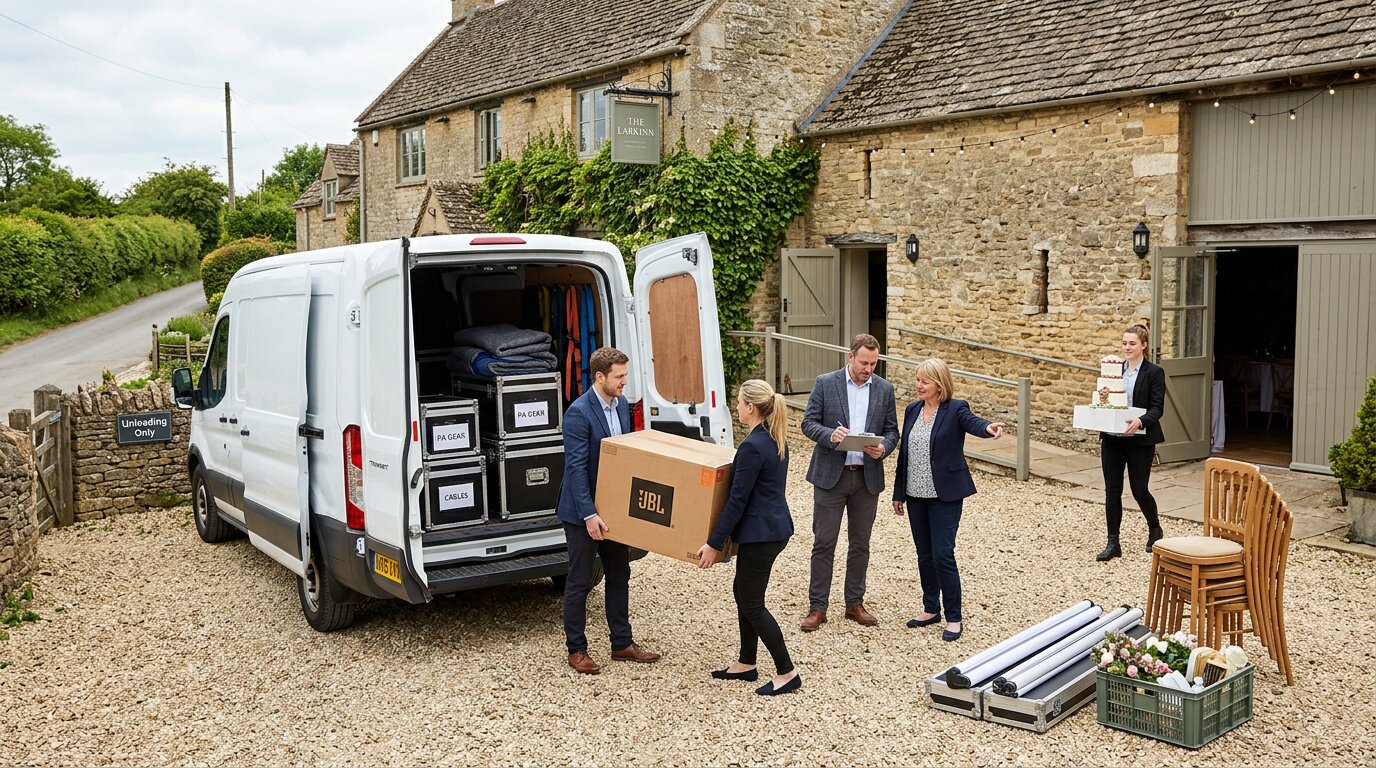
Pub function rooms, community centre halls and country venues are often booked on a “you bring the rest” basis. The room, the bar or kitchen and maybe some tables come with the booking. The PA, the backdrop, the cake stand, the boxes of jam-jar candles and the hired chairs are your problem.
The short version: get the venue’s delivery rules in writing first, list the load by size rather than by item, book a vehicle that matches that list, and agree with the venue exactly who is there when the gear arrives and when it goes. Most event-day stress at small venues comes from the last ten metres, not the drive.
Ask the venue the questions that aren’t on the booking form
Booking forms ask about numbers, food and timings. They rarely ask how your gear will get in. Old pubs and converted barns can be awkward: a narrow side gate, a step down into the function room, a car park that fills with diners by six. Community centres have their own quirks, such as a shared car park with an evening class or a caretaker who locks up at a fixed time.
Ask the venue manager:
- Where should vehicles stop to unload, and is there a time when that space is clear?
- What is the earliest you can get in, and is someone there to open up?
- Is there a route to the room without steps, and how wide is the narrowest door on it?
- Can anything be stored overnight, and is it the venue’s responsibility while it’s there?
- When does everything have to be out, and does the bar staff’s or caretaker’s closing time change that?
- Are there rules on your own suppliers, open flames, confetti or fixings to walls?
If the unloading point is on the street, check the kerb before the day. The Highway Code’s rule 247 says not to load or unload where yellow kerb markings and upright signs show restrictions are in place. A quiet village lane can still have them.
List the load by shape, not by item
“Decorations, sound system, drinks for the table plan” doesn’t tell you what vehicle you need. Measurements do. Go through everything and write down three things for the bulky items: the longest dimension, anything that can’t be tipped on its side, and anything that takes two people to lift.
Long items such as banner stands, trestle tables and lighting poles decide the vehicle more than total volume does. Fragile items such as a tiered cake, glass vases or a framed seating plan need to travel flat and wedged, and ideally go in last so they come out first.
The Highway Code’s rule 98 says you must secure your load. In practice that means bringing straps or blankets, because a hire van’s load area usually comes empty.
Choose the vehicle, then separate the people
Once the list exists, it’s easier to see whether a car boot and a couple of trips will do, or whether a van makes sense. Most small vans and standard panel vans are within the category B car licence limit of 3,500kg maximum authorised mass for petrol and diesel vehicles, according to GOV.UK. Check the plated weight if you’re offered anything larger, such as a Luton with a tail lift.
People and equipment are separate journeys. A van carries only as many people as it has seats in the cab. Nobody rides in the back with the chairs. If your set-up crew is bigger than the cab, the rest come by car.
A hypothetical example: a family is throwing a sixtieth birthday in a pub function room. The venue supplies tables and the bar. The family brings a hired PA, two banner stands, twelve boxes of table decorations and a cake. The banner stands are 2m long in their bags, so a small car is out. A short-wheelbase van handles everything in one trip, while the cake travels separately in a car, boxed and flat in the passenger footwell. Two family members ride in the van cab. The other two helpers drive.
Two enquiry examples
The examples below are regional, one in Wiltshire and one in west Dorset, and are listed only as places to ask about vans. Neither is local to every reader, no venue endorsement is implied, and neither has been compared with other hirers. Whichever area your event is in, the questions are the same.
Swindon, Wiltshire
Website: van hire information for Swindon on VanHire.UK.com, a national van hire website.
Service shown: van hire in Swindon, from short-wheelbase panel vans up to Luton and dropwell Luton vans, with delivery and collection advertised.
Worth asking: who actually supplies the van locally, whether delivery to a venue rather than a home address is possible, and the exact internal load length of the van you’d be given.
Bridport, Dorset
Website: van availability in Bridport at vanhirebridport.co.uk.
Service shown: van hire in Bridport, with a fleet list running from small vans to a Luton with tail lift, and delivery and collection advertised.
Worth asking: whether the van can be dropped at the venue on the morning of the event, what the deposit and insurance excess are, and whether a tail-lift vehicle is available on your date.
With either, confirm the details directly before you book. Don’t rely on general website copy for the vehicle size, the price or the mileage terms.
The venue handover sheet
Fill this in with the venue a week before. Print two copies: one for the venue, one in the van.
| Field | Load-in | Collection |
|---|---|---|
| Date and time window | ||
| Venue contact on site (name, mobile) | ||
| Your contact on site (name, mobile) | ||
| Where the vehicle stops | ||
| Kerb or car park restrictions checked? | ||
| Route to the room (steps, narrowest door) | ||
| Items arriving / leaving (count) | ||
| Third-party hires (PA, chairs, linen): who collects? | ||
| Overnight storage agreed? Where? | ||
| Hire vehicle return time |
Collection is where things go missing
Set-up gets all the planning. Pack-down happens late, with tired people, while the venue wants its room back. A few habits help:
- Count items in and count them out. The handover sheet’s “items” line exists for this.
- Give third-party hire items their own corner so they don’t go home in the wrong car.
- If the van has to go back the same evening, check the return time against the end of the event before you book. If it doesn’t fit, ask about next-morning collection from the venue, and confirm that the venue is happy to keep the gear overnight.
- Walk the room once it’s empty. Candles, cable ties and the cake knife are the usual leftovers.
A pub or community centre that hosts functions every week has seen every version of a chaotic load-in. Turning up with a sheet that answers their questions before they ask is the easiest way to get a little goodwill on the day.